Seatoller in Cumbria was the starting point for exploring the Village HeatShare approach. The Heatoller project, funded by the North West Net Zero Hub's regional share of the Great British Community Energy Fund, investigated how local hydroelectric renewable energy could be combined with a small, community-focused data centre in the hamlet of Seatoller to capture and reuse surplus heat, providing low-carbon heat to nearby homes and community buildings.
The project explored the potential for this model in a real rural setting, looking at the renewable resource, local heat demand, technical requirements and how the approach could deliver wider benefits for the small community and local businesses. The project aims to reduce reliance on oil and LPG heating, lower carbon emissions, improve energy resilience, and demonstrate how rural communities can benefit directly from locally generated renewable energy.
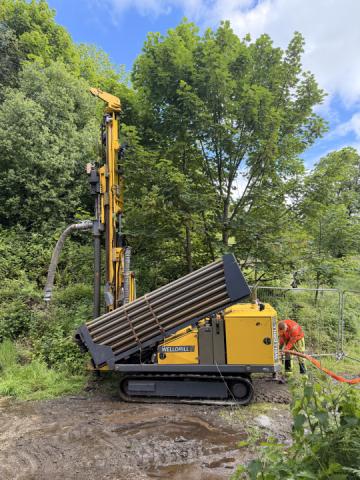
A key part of the project was investigating the potential for ground source heat, utilising boreholes for heat storage and balancing supply and demand. A test borehole was drilled at Seatoller farm in June 2026 to explore the ground conditions and geothermal potential of the site. The drilling reached approximately 199.5 metresThe drilling confirmed favourable geological conditions and encountered groundwater at around 67 metres, while the notable temperature difference in the water circulating out the pipe suggests strong potential for ground source heat applications. Thermal response testing confirmed that the borehole is a good thermal conduit, demonstrating promising ground-source heat pump potential, with a measured thermal conductivity of 2.4W/mK and an undisturbed ground temperature of 10°C
The Heatoller feasibility project was supported through the Great British Energy Community Fund, and the resulting feasibility work has now helped inform the wider Village HeatShare approach.
Seatoller is therefore the first step—not the finished model. The next stage is to look for other rural communities with similar opportunities and explore how the approach could be adapted to different local circumstances. Through Village HeatShare, we're now aiming to identify 100 potential sites and develop a pipeline of communities where local renewable energy, edge data centres and low-carbon heat could work together.
Could your community be a good fit?